 Buying a mobile phone is no longer just about choosing the latest model. With hundreds of smartphones available at different prices, finding the right one can be confusing. A good mobile phone should match your daily needs, budget, performance expectations, and lifestyle.
Whether you need a phone for studying, business, photography, gaming, social media, or everyday communication, making the right choice can save you money and give you a better experience.
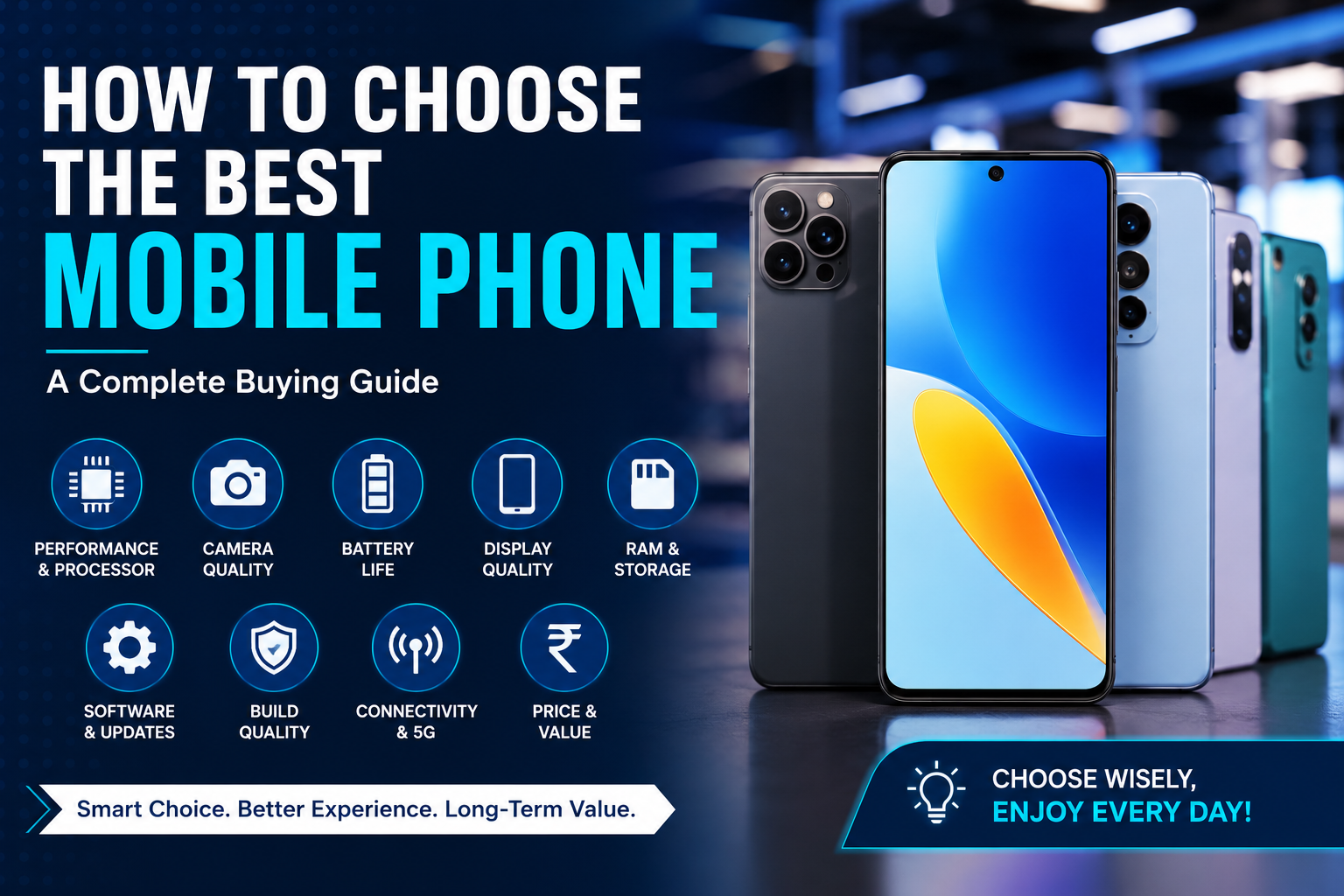
In this guide, we will explain how to choose the best mobile phone by looking at the most important features, including performance, camera, battery, display, storage, software, and price.
What Should You Look for in a Mobile Phone?
Before purchasing a smartphone, think about how you will actually use it. The most expensive mobile phone is not always the best choice for every customer.
Here are the key factors you should consider:
- Performance and processor
- RAM and storage
- Camera quality
- Battery life and charging
- Display quality
- Software and updates
- Build quality
- Connectivity
- Price and value for money
Let’s understand each factor in detail.
1. Choose a Mobile Phone According to Your Budget
The first step is to decide how much you are comfortable spending.
Mobile phones are available in different price segments, from affordable entry-level devices to premium flagship smartphones. Instead of buying a phone simply because it is expensive, compare the features you actually need.
For example:
Budget cell phones: Suitable for calling, messaging, social media, online classes, and basic apps.
Mid-range mobile phones: Suitable for users who want better cameras, stronger performance, larger storage, and a smoother overall experience.
Premium mobile phones: Suitable for customers who want high-end cameras, powerful processors, premium displays, advanced features, and long-term performance.
A smart buyer should focus on value for money rather than price alone.
2. Check the Processor and Performance
The processor is one of the most important components of a mobile phone. It affects how quickly apps open, how smoothly games run, and how well the phone handles multitasking.
If you mainly use your phone for calls, WhatsApp, YouTube, browsing, and social media, you may not need the most powerful processor.
However, if you regularly play demanding games, edit videos, or use several applications simultaneously, choose a phone with a stronger processor.
Why Performance Matters
A good processor can provide:
- Faster app loading
- Smooth multitasking
- Better gaming performance
- Efficient power consumption
- Longer useful life
Always compare the actual processor model rather than choosing a phone only because it has a large RAM number.
3. How Much RAM and Storage Do You Need?
RAM helps your mobile phone handle multiple applications. Storage is where your photos, videos, apps, documents, and other files are saved.
For everyday users, moderate RAM and storage may be enough. Heavy users should consider higher storage and RAM.
Before buying, ask yourself:
How many photos and videos do I store?
Do I play large games?
Do I download movies or other offline content?
Will I keep this phone for several years?
If you store a lot of files, choosing higher internal storage can be a better long-term decision.
4. Camera: Don’t Judge a Mobile Phone Only by Megapixels
Camera quality is one of the biggest factors customers consider when buying a smartphone. However, a higher megapixel number does not automatically mean a better camera.
Look at features such as:
- Main camera quality
- Low-light performance
- Image processing
- Video recording
- Front camera quality
- Ultrawide camera
- Optical image stabilization, where available
If photography is important to you, check real-world camera samples and reviews instead of comparing megapixels alone.
For social media users, a good front camera and video quality may be more important than having the highest-resolution sensor.
5. Battery Life and Charging Speed
Nobody wants a mobile phone that constantly needs charging.
Battery capacity is usually measured in mAh, but battery life also depends on the processor, display, software optimization, network usage, and how you use the phone.
A good mobile phone should comfortably handle your normal daily activities.
If you use your smartphone heavily for gaming, video streaming, navigation, or social media, look for a device with strong battery endurance.
Fast charging can also be useful when you need to recharge your phone quickly.
6. Choose the Right Display
You interact with your mobile phone through its display, so screen quality matters.
Consider:
- Screen size
- Resolution
- Refresh rate
- Brightness
- Display technology
- Protection against scratches
A larger screen can be useful for watching videos, reading, gaming, and working. A smaller phone may be more comfortable for people who prefer easy one-handed use.
A higher refresh rate can also make scrolling and animations feel smoother.
7. Software and Updates Matter
Many customers focus on hardware but forget about software.
A mobile phone with good hardware can still become frustrating if the software experience is poor.
Before purchasing, check:
- Operating system
- Software features
- Security updates
- Major software update policy
- Pre-installed applications
- User interface
Regular software and security updates can make your smartphone safer and more useful over a longer period.
8. 5G and Connectivity
If you are purchasing a new mobile phone, connectivity is another important factor.
Depending on your location and mobile network, you may want to consider:
- 5G support
- Wi-Fi capabilities
- Bluetooth
- GPS
- NFC, if required
- SIM support
5G can provide faster mobile data where compatible networks are available. However, don’t pay extra for connectivity features you don’t actually need.
9. Build Quality and Design
A mobile phone is something you may use every day for several years. Therefore, build quality should also be considered.
Look at the materials, frame construction, screen protection, weight, and overall design.
If you frequently travel or work outdoors, durability may be more important than having an extremely slim design.
Using a good protective case and screen protector can also help protect your investment.
10. Don’t Ignore Customer Reviews
Before buying a mobile phone, read reviews from multiple reliable sources.
Reviews can help you understand things that specifications don’t always show, such as:
- Real battery performance
- Camera performance
- Heating
- Gaming experience
- Software problems
- Speaker quality
- Network performance
- Long-term usability
Don’t rely on a single review. Compare several opinions and look for common feedback.
Best Mobile Phone for Different Types of Users
There is no single mobile phone that is perfect for everyone. Your best choice depends on your requirements.
Mobile Phone for Students
Students may prioritize:
- Long battery life
- Good performance
- Comfortable display
- Reliable connectivity
- Enough storage
- Affordable pricing
A balanced phone is usually better than spending extra money on features you won’t use.
Mobile Phone for Photography
Photography-focused users should prioritize:
- Good main camera
- Image stabilization
- Strong image processing
- Good low-light performance
- Quality video recording
Mobile Phone for Gaming
Gamers should look for:
- Powerful processor
- Adequate RAM
- High-quality display
- Good cooling
- Long battery life
- Fast charging
Mobile Phone for Business Users
Business users may prefer:
- Reliable performance
- Strong battery life
- Good security
- Quality display
- Good call quality
- Enough storage
Common Mistakes to Avoid When Buying a Mobile Phone
Choosing a smartphone becomes easier when you know what mistakes to avoid.
Buying Only Because of the Camera
A phone may have impressive camera specifications but poor overall performance. Consider the complete package.
Choosing the Highest RAM
More RAM is not automatically better. The processor, software optimization, and storage also affect performance.
Ignoring Software Updates
A phone that receives regular updates can provide better security and a more reliable experience over time.
Buying More Features Than You Need
If you only use your phone for communication and basic apps, paying a premium for advanced gaming or photography features may not be necessary.
Not Comparing the Total Value
Compare phones based on performance, camera, battery, display, software support, storage, and after-sales service—not just the price.
How to Choose the Right Mobile Phone: Quick Checklist
Before making your final decision, ask yourself:
- What is my budget?
- What will I mainly use the phone for?
- Do I need a powerful processor?
- How much storage do I need?
- Is camera quality important to me?
- How much battery life do I need?
- Do I need 5G?
- How long do I plan to keep the phone?
- Does the manufacturer provide good software support?
- Is the phone good value for money?
If you can answer these questions, you will have a much clearer idea of which mobile phone is right for you.
Final Thoughts
Choosing the best mobile phone is not about buying the most expensive or newest device. It is about finding the phone that offers the right combination of performance, camera quality, battery life, display, storage, software, features, and price for your needs.
Before purchasing, compare several models, read genuine reviews, check the specifications carefully, and think about how you will use the phone every day.
A little research before buying can help you choose a mobile phone that gives you better value and a satisfying experience for years to come.
Frequently Asked Questions
Which mobile phone is best for everyday use?
The best mobile phone for everyday use is one that provides reliable performance, good battery life, sufficient storage, a quality display, and useful software features within your budget.
How much RAM is enough for a mobile phone?
The ideal RAM depends on how you use your phone. Basic users need less RAM, while gamers and heavy multitaskers may benefit from more. Don’t judge performance by RAM alone.
Is a higher megapixel camera always better?
No. Camera quality depends on several factors, including the sensor, lens, image processing, stabilization, and software.
Should I buy a 5G mobile phone?
If 5G is available in your area and you plan to keep your phone for several years, 5G support can be useful. However, it should not be the only reason to choose a particular phone.
How can I get the best value from my mobile phone purchase?
Set a realistic budget, identify your main requirements, compare several models, read independent reviews, and choose the phone that offers the best combination of features and long-term value.
Focus Keyword: Mobile Phone
Suggested SEO Title: How to Choose the Best Mobile Phone: A Complete Buying Guide
Suggested Meta Description: Looking for the best mobile phone? Learn how to choose the right mobile phone based on performance, camera, battery, display, storage, software and price.
Suggested URL Slug: how-to-choose-best-mobile-phone
Leave a Reply